


“SEO” is a term that has been dangerously watered down. You can buy “Basic SEO” for the price of a cheap dinner, usually consisting of some meta tag tweaks and a few dodgy backlinks. On the surface, it looks like you’re doing something. In reality, you are building a house on sand. Basic SEO treats Google like a 1990s filing system; Strategic SEO treats it like the massive, AI-driven neural network it actually is in 2026.
If your traffic has flatlined despite “doing the work,” you are stuck in the basic execution phase. Winning in a hyper-competitive market takes more than just keywords—it takes engineering. This is why serious brands eventually hire SEO experts who can stop chasing the algorithm and start out-maneuvering it.
Keywords vs. Entity-Based Optimization
Basic SEO is obsessed with keyword density. It’s a primitive game of repeating a phrase until a bot notices you. But modern search uses Named Entity Recognition (NER). Google doesn’t just see the word “Apple”; it looks at the “entities” around it to decide if you’re selling fruit or iPhones.
Strategic execution builds a Knowledge Graph for your site. We use advanced Schema Markup to tell the search engine exactly who you are and why you own your niche. By connecting your brand to these digital entities, you aren’t just ranking for a word—you are becoming the “Source of Truth” for that entire topic.
The “Crawl Budget” and Technical Efficiency
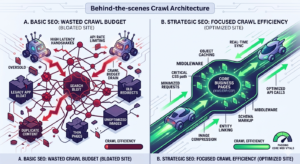
A basic service won’t ever look at your server logs. They assume that if a page exists, it’s being found. But for any site with scale, Google sets a “Crawl Budget.” If your site is a mess of redirect loops, 404s, or bloated images, the search bots will leave before they ever find your money-making pages.
Professional SEO services prioritize “Crawl Efficiency.” We audit your internal links and kill the “thin” content that’s wasting the bot’s time. We make sure every millisecond a search bot spends on your site is focused on high-value, high-intent pages.

Content Volume vs. “Information Gain”
The basic approach is simple: pump out as much content as possible. This results in a graveyard of generic, AI-rehashed blog posts that offer zero new value. In 2026, Google uses an Information Gain score. If your page just says what the top five results already say, you will never outrank them.
Strategic SEO requires “Human-First” content—unique data, contrarian opinions, or actual case studies. At Digipie Technologies, we don’t just write; we solve specific user problems that aren’t being addressed elsewhere. This builds Topical Authority, making your rankings incredibly hard for a competitor to steal.
Backlinks vs. E-E-A-T and Digital PR
Anyone can buy a thousand links from a farm, but that’s a fast track to a manual penalty. Basic SEO chases quantity. Strategic SEO chases Digital PR and the E-E-A-T framework (Experience, Expertise, Authoritativeness, Trustworthiness).
We focus on earning mentions from high-authority, niche publications. One link from a major industry journal is worth more than ten thousand links from “guest post” sites. It signals to Google that you are a trusted leader, not just another site trying to “game” the system.
Conversion Rate Optimization (CRO) Integration
The biggest failure of Basic SEO? It stops at the click. If you get 10,000 visitors but your bounce rate is 90%, you aren’t winning; you’re losing money. Strategic execution bridges the gap between SEO services and User Experience (UX).
By analyzing “User Intent,” we make sure the person clicking is actually finding the solution. We optimize the “Interaction to Next Paint” (INP) speeds and place clear “Calls to Action” (CTAs). SEO is a waste of time if it doesn’t lead to revenue.
FAQs:
1. What is the “Information Gain” score?
It’s a 2026 metric used to see if your content provides new value. If you’re just repeating what’s already out there, you’ll be pushed to the second page.
2. Can’t I just use an SEO plugin?
Plugins are for tracking, not for thinking. A tool can find a broken link, but it can’t build a “Topical Map” or out-think your competitors’ PR strategy.
3. How long until I see real results?
For strategic work, expect 4 to 6 months. We are fixing deep technical issues and building real authority. The upside? Those rankings are much harder to lose during algorithm updates.